JA’s first wife
Context
This page draws on court records, newspapers, and official documents. Some language reflects the attitudes of the period and is presented here for historical context.
Much has been written and speculated over the years about the anomalies that appear on the birth certificates of Joseph Alexander Miller’s nine children with Ann Elizabeth Chalker. These irregularities — shifting maternal names, repeated marriage dates, and inconsistent personal details — were what first prompted deeper investigation.
Over time, I have been able to obtain original birth certificates for Josephine, Charles, Margaret, Patrick, and Albert. For the remaining four children, only typed extracts survive, which omit much of the contextual information found on the originals. It was through careful comparison of these documents that the same dates and names began to recur, raising questions that could not be answered by the children’s records alone.
Those answers lie with Joseph Alexander Miller’s first wife, Mary Ann Rayner.
After many years of searching, in 2019 I located the marriage certificate of Joseph Miller and Mary Ann Rayner, dated 16 January 1891. The groom is recorded simply as Joseph Miller, occupation cook, and the marriage took place at Bethel House, a mission church for mariners — an entirely consistent setting for a Jamaican-born seaman who had worked as a ship’s cook and steward before his discharge in 1888. On the certificate, Mary Ann Rayner is recorded as a widow.
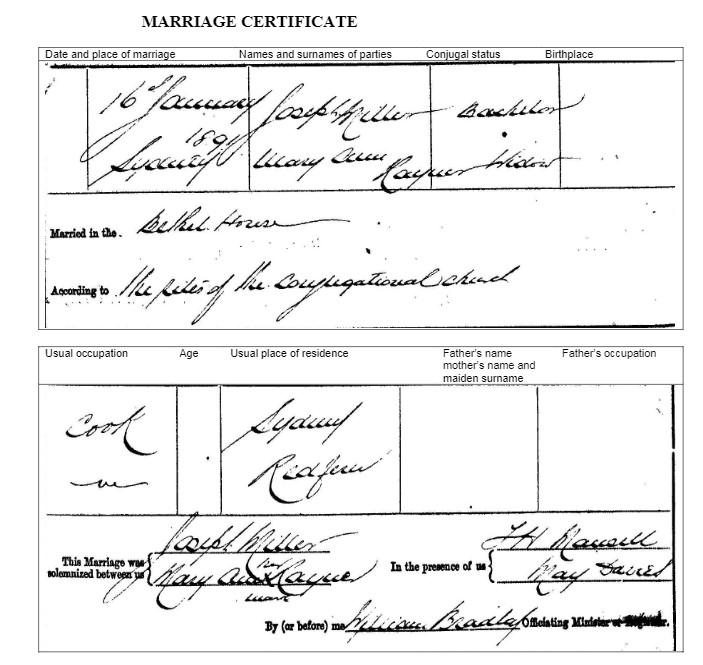
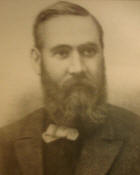
At first glance, the certificate could appear ambiguous. Joseph Miller was not an uncommon name. However, the occupation, location, and church all align closely with what is known of JA at that time.
What followed the marriage does not appear in any celebratory record. Within a short period, the relationship collapsed. Joseph left Mary Ann, sold what property he had, and formally distanced himself from responsibility for her debts.
On 3 April 1893, he placed an advertisement in the Evening News stating that he would no longer be responsible for debts incurred by his wife.

This public notice suggests not a temporary separation, but a deliberate and final rupture.
In the years that followed, Mary Ann appears repeatedly in police and court records under variations of her married name:
- 17 January 1895 — fined as Mary Ann Miller for threatening to tear out the liver of Constable Williams
- 24 September 1897 — fined as Elizabeth Miller for using indecent language
- 17 December 1900 — fined as Mrs Miller for drunkenness
Taken together, these records paint a picture of a woman living on the margins of respectability, frequently in contact with police and often intoxicated — though they must also be read in the context of how working-class women were policed, judged, and publicly shamed at the time.
The clearest insight into the situation comes from 1903, when Mary Ann brought a case against Joseph Miller for desertion and maintenance. By this time, JA was operating a low-cost restaurant and offering beds for the night near Goulburn Street, and was living openly with Ann Elizabeth Chalker, who had already borne him several children.
Mary Ann testified that she had been living apart from her husband for around thirteen years and claimed she had only recently discovered his whereabouts when she noticed the name “Mrs Miller” above a doorway in George Street. She stated that he had left her years earlier after taking a bill of sale over their possessions, and that she had been unaware of his location until that moment.
Joseph’s defence was uncompromising. He alleged adultery, habitual drunkenness, and dishonesty. The court heard evidence that Mary Ann had been living with a man named Rayner, paying rent in his name, and that the two appeared to be husband and wife, occupying a single bed. A property owner, Edward Croker, testified that Mary Ann occupied one of his houses with a man named Rayner, and that the rent was paid in Rayner’s name.
The magistrate ultimately dismissed Mary Ann’s claim, finding that she had no standing to seek maintenance.
Source: 23 Aug 1903 – MILLER’S MISSUS. – Trove
This is the transcript of the attached link. “MILLER’S MISSUS”
Impudence and Hard Swearing Martyr(?) Mr’s Miller
Mrs Miller Denies Unchastity, but Her Husband Accuses Her of Adultery
When a decent woman is deserted by the man that had sworn to love her and to cherish her, she has everybody’s sympathy, and the law provides for her a legal remedy by means of which she can compel her wife-deserting husband to support her. Unfortunately, however, not all women are like the woman whom we have just referred. Some of them are DRUKEN, RIOTOUS REPROBATES and in addition, adulterers.
An instance of this depravity, bare-faced impudence, and contempt for the solemnity of an oath that characteries some women was given before Mr Donaldson, SM, last Wednesday, on which day, in the Summons Division of the Police Court Mary Ann Elizabeth Miller sued her husband for maintenance. The husband is a man of colour and is, it appears, the proprietor of a 4d Restaurant IN GEORGE STREET, near Goulburn Street.
His wife is a gross and corpulent woman who, though posing as an injured innocent, is declared by her husband and her landlord TO BE AN ADULTERESS. Mrs. Miller was rendered the legal assistance of Mr. Sidney Stewart, and the husband was represented by Mr. J. W. Abigail.
The complainant swore that she was a married woman living apart from her husband, her present address being 1 Middle-street, Chippendale. She had been living apart from her husband for about 13 years. She had, in fact, been UNAWARE OF HIS WHEREABOUTS until about 12 months ago. He had, she declared, got a bill of sale over the ‘things’ 13 years ago, and then left her. One day, about 12 months ago, she was in George-street, near Goulburn Street, when she saw the name ‘MRS. MILLER’ OVER A DOOR, and she discovered that this was the residence of her husband.
She then wrote to him asking for help, and the result was that he gave her £1, but had not given her anything since. She asked for £1 which he was, she declared, well able to pay He was, said she, living with a woman, who had borne him three children and was going to have another.
It was when this amiable and sweet witness was cross-examined that she appeared, at first, to be AN ABSOLUTE MARTYR.
In answer to Mr. J. W. Abigail, she declared that her husband had never caught her in bed with a man named Harry York. Although it was true that she kept a boarding-house, the boarder therein, one Raymond, was not known as husband. She had never been convicted of drunkenness, and, in fact, had never been charged with any offences at any court. Her answers were given with so much indignation and so emphatically that Mr. Stewart implored the witness NOT TO’ GET EXCITED. ‘It’s enough to make her excited if there’s no truth in these charges,” said Mr. Abigail.
The attorney for the defendant then informed his Worship that he had every confidence in his client’s story and would therefore ask for an adjournment in order to call fresh evidence. He would, he said, at once throw up his brief if he did not BELIEVE HIS CLIENT’S STORY. Mr. Donaldson said that he had no doubt he would, and he granted an adjournment until Friday.
On Friday Mrs. Miller denied that she was convicted for drunkenness on December 17, 1900; denied that she was ever arrested by Constable Pauling or Constable Robins and fined. She was not convicted under the name of Mary Ann Miller on January 17, 1895, she said and fined. She had never threatened to tear out the liver of Constable Williams. She had never ADMITTED COMMITTING ADULTERY with ‘Bob the baker.’ She had lived at 30 Chambers-street, Ultimo. It was a four-roomed house. Charles Raymond boarded there. (A man was here put out of court.)
The man, MacDonald, just put out of court had boarded with her. There were two bedrooms in the Chambers-street house. The rent receipts were given in Raymond’s name. She had never committed adultery with Raymond. She was not fined on September 24, 1897, under the name of Elizabeth Miller, for USING INDECENT LANGUAGE.
She was summoned and fined on that date.
Edward Croker, a property owner, said that complainant occupied one of his houses with a man named Rayner. The rent was paid In Rayner’s name. The two appeared to be man and wife. Witness had often been through the house and had seen only one bed in it.
Here we have the woman admitting herself that she had been fined, although she had sworn that she had never been before a Court. His Worship was quite satisfied that she had no locus standi, and he therefore dismissed the case.”
The language of the article is brutal, racist, and sensationalist — particularly in its description of Joseph as “a man of colour” — but when read alongside independent records, it confirms several key facts rather than undermining them.
Once this broader context is understood, the anomalies on the children’s birth certificates become more comprehensible. Joseph and Ann Elizabeth were never legally married during the years their children were born. Joseph was still legally married to Mary Ann Rayner. As a religious man, he appears to have been unwilling to commit perjury by claiming a marriage that did not exist, yet equally unwilling to publicly acknowledge a situation that would have invited social condemnation.
As a result, Mary Ann’s name, or variations of it, appears as the legal wife on early certificates. The same marriage date — 16 January 1891 — is reused repeatedly. Ann Elizabeth’s identity is partially obscured, despite being clearly the biological mother of all nine children.
Joseph Alexander Miller did not marry Ann Elizabeth Chalker until 1927, after Mary Ann Rayner’s death. On that marriage certificate, Joseph is recorded as a widower. This final document resolves decades of ambiguity.
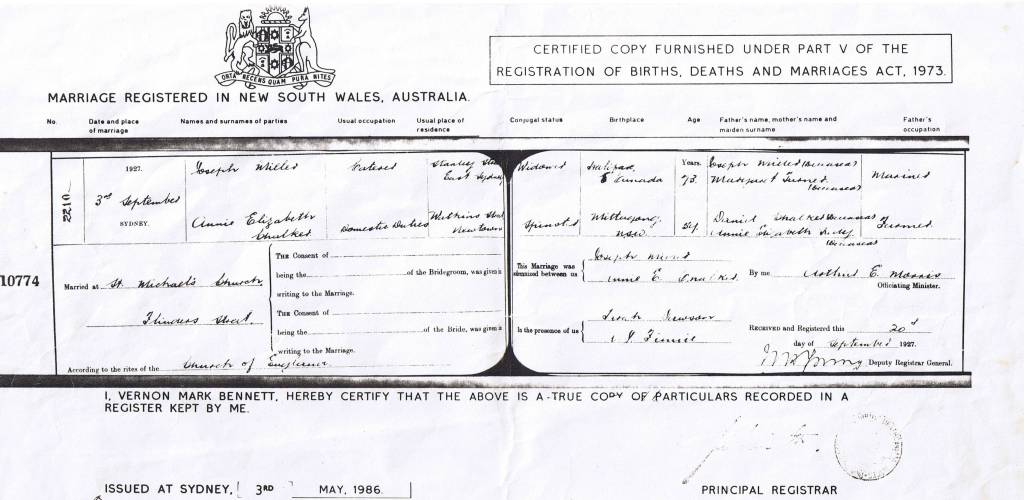
In April 1930, three years after Joseph and Ann Elizabeth were finally able to marry, the couple returned together to the registry to formally correct a number of earlier birth records.
These amendments were made to the original birth certificates of Josephine, Charles, Margaret, and Patrick. The changes were not new registrations, but official alterations to existing records.
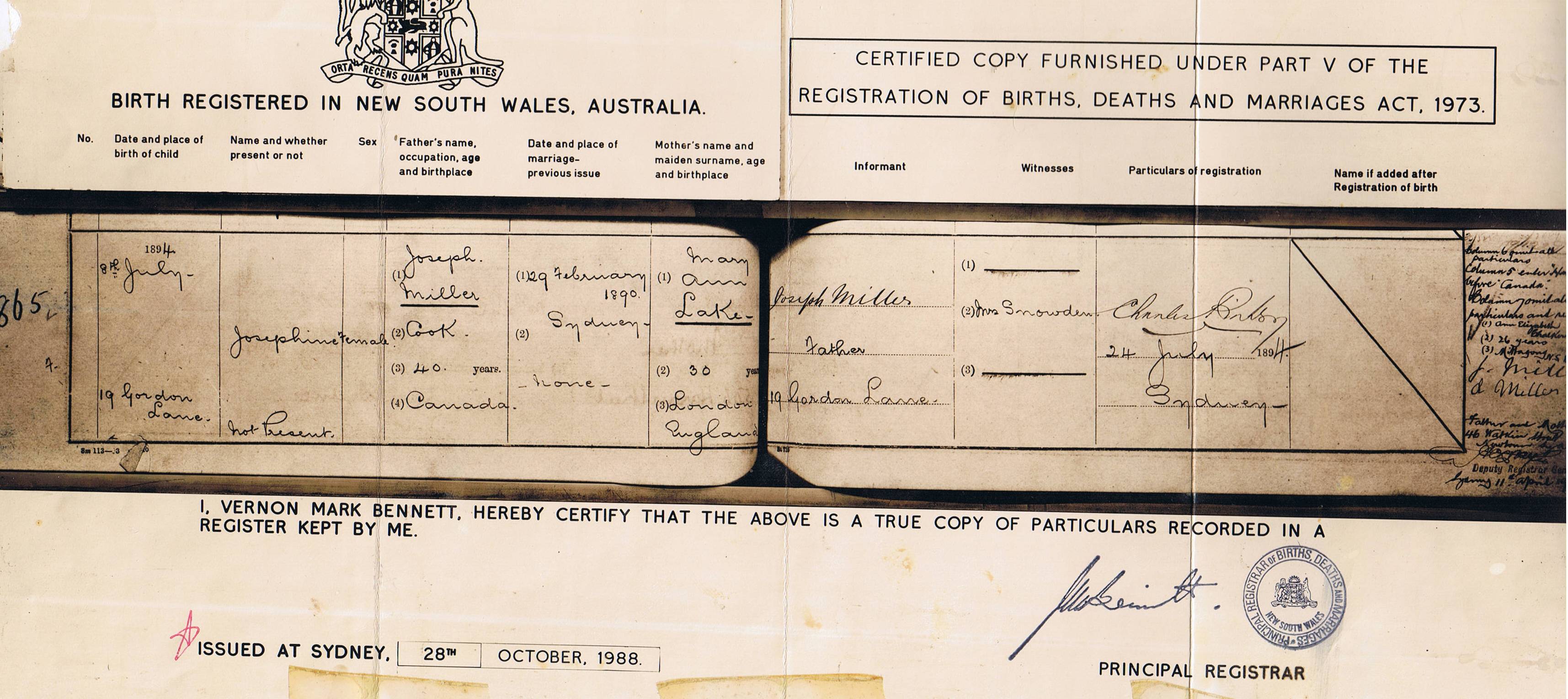
On Josephine’s birth certificate, the mother was amended from Mary Ann Lake of London, aged 30, to Ann Elizabeth Chalker of Mittagong, aged 26. Joseph’s birthplace was corrected from Canada to Halifax, Canada, and the recorded marriage date of 29 February 1890 was deleted.
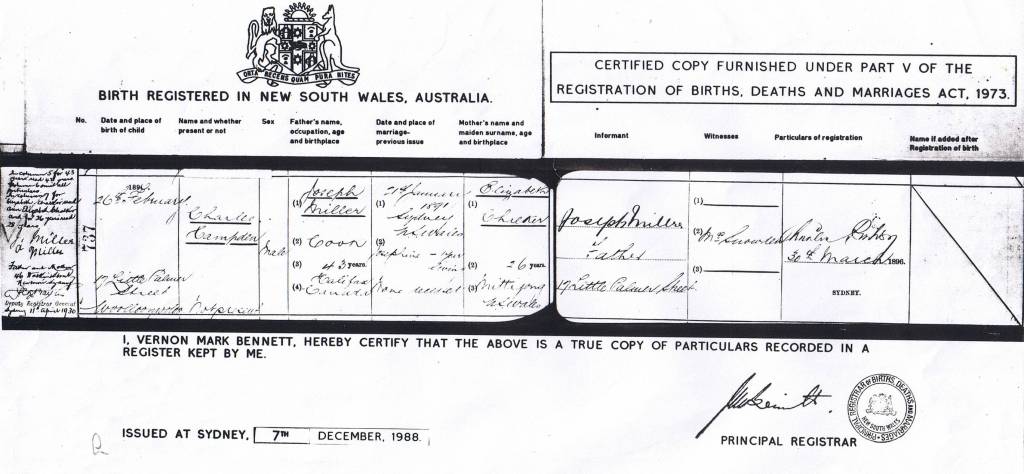
On Charles’s certificate, the mother was corrected from Elizabeth Chalker, aged 26, to Ann Elizabeth Chalker of Mittagong, aged 28. Joseph’s birthplace was already recorded as Halifax, Canada, and the marriage date of 21 January 1891 was deleted.
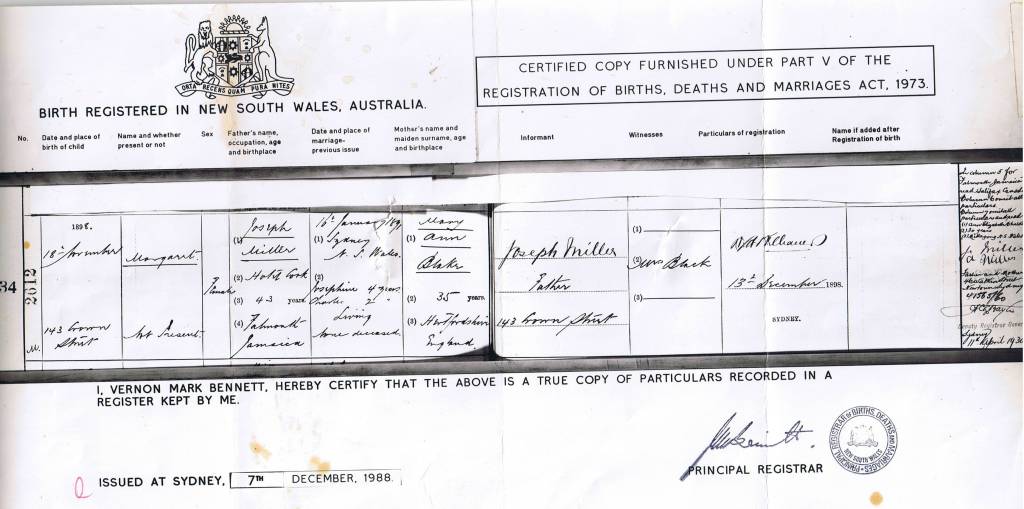
Margaret’s birth certificate was similarly amended. The mother was changed from Mary Ann Blake/Lake of Hertfordshire, aged 35, to Ann Elizabeth Chalker of Mittagong, aged 30. Joseph’s birthplace was corrected from Falmouth, Jamaica to Halifax, Canada, and the marriage date of 16 January 1891 was removed.
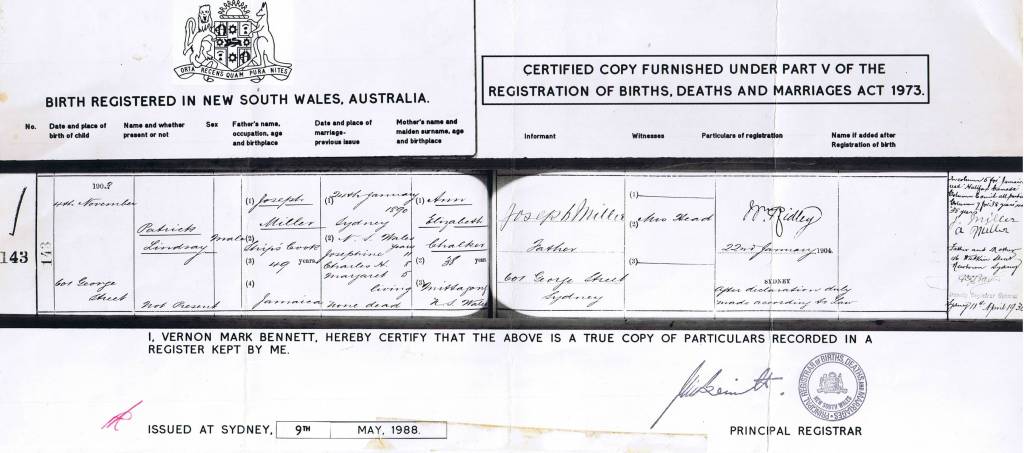
Patrick’s certificate already named Ann Elizabeth Chalker of Mittagong as the mother. In this case, Joseph’s birthplace was amended from Jamaica to Halifax, Canada, and the recorded marriage date of 24 January 1890 was removed.
Taken together, these corrections represent the first time the public record was able to reflect the reality of the family as it had existed for decades. Only after Joseph was legally free to marry Ann Elizabeth could these details be corrected without perjury or legal consequence.
These amendments do not erase the earlier anomalies — they explain them.
Further confirmation comes from the Sands Directory and rate assessment records. In 1902–1903, Charles Rayner is recorded as living at 30–32 Chambers Street, Ultimo, with his wife Mary Ann Rayner.
Rate assessment notices from 1905 also show an Elizabeth Miller renting at 32 Chambers Street, with Edward Croker listed as landlord. https://archives.cityofsydney.nsw.gov.au/nodes/view/1842195#idx2541423
By 1905–1906, Sands Directory entries record Charles Rayner living at 1 Middle Street, Chippendale — the same address Mary Ann gave in court.
Mary Ann Rayner’s story is not a simple one, nor is it a comfortable one. She appears in the records as volatile, unreliable, and often intoxicated, but also as a woman attempting, however imperfectly, to assert her rights within a system that offered her little dignity or protection.
Joseph Alexander Miller’s response was equally complex: abandonment, concealment, and silence rather than confrontation or divorce. Ann Elizabeth Chalker, meanwhile, lived for decades in a legal limbo, raising children whose legitimacy could not be formally acknowledged until late in life.
What remains, more than a century later, is a paper trail marked by omission, repetition, and compromise — and a family history shaped as much by what could not be said as by what was written.
 Joseph Alexander Miller 1854-1939